[Capabilities // Full-Funnel Revenue Systems]
Four integrated disciplines.
Zero vanity metrics.
A retainer agency sells you four separate channels and bills you for each one. Search optimizes clicks. Social optimizes reach. CRO optimizes pageviews. Nobody owns the number that actually pays your payroll. We run all four as a single revenue system: search captures demand at the moment it exists, social manufactures demand before it does, CRO strips the friction out of the traffic both produce, and message-matched landing pages close it. Every discipline writes into the same server-side data layer, so a fix in one directly improves the economics of the other three—and the return compounds instead of resetting every quarter.
← one pod. one data layer. one P&L.
$48M+
Across Google, Meta, and retail media since 2019.
+38%
Measured against the account’s own pre-engagement baseline.
04
Search, social, CRO, and pages run by one senior pod.
[Index // The Four Disciplines]
Read the system in order.
[01 // Google Ads Acquisition Engine]
01 / 04Own the moment demand exists.
Search intent is a closing signal, not an audience to be warmed. We rebuild the account around query economics: themed exact-match ad groups with phrase coverage held in a separate campaign, brand terms quarantined into their own campaign with a hard spend ceiling, and Performance Max fed one asset group per margin tier so the algorithm never averages a high-value service line against a low-value one.
Bidding runs on revenue, not form fills. Offline conversions are imported from your CRM so Smart Bidding optimizes toward closed deals, portfolio targets are set per service line, and no campaign is switched to tCPA before it has logged 30 conversions. Search-term waste is mined by n-gram every week, and any query above 1% of spend with zero conversions enters the negative register the same day.
Non-negotiable // Brand spend capped at 8% of total account spend. Verified in-platform.
Deliverables ledger
Spec
- Campaign & ad group architecture map
- 1 file
- Offline conversion schema, CRM → Google Ads
- Built + QA
- Negative keyword register, n-gram mined
- Weekly
- Bid governance model, tCPA by margin tier
- 1 sheet
- Query-to-revenue report with waste log
- Monthly
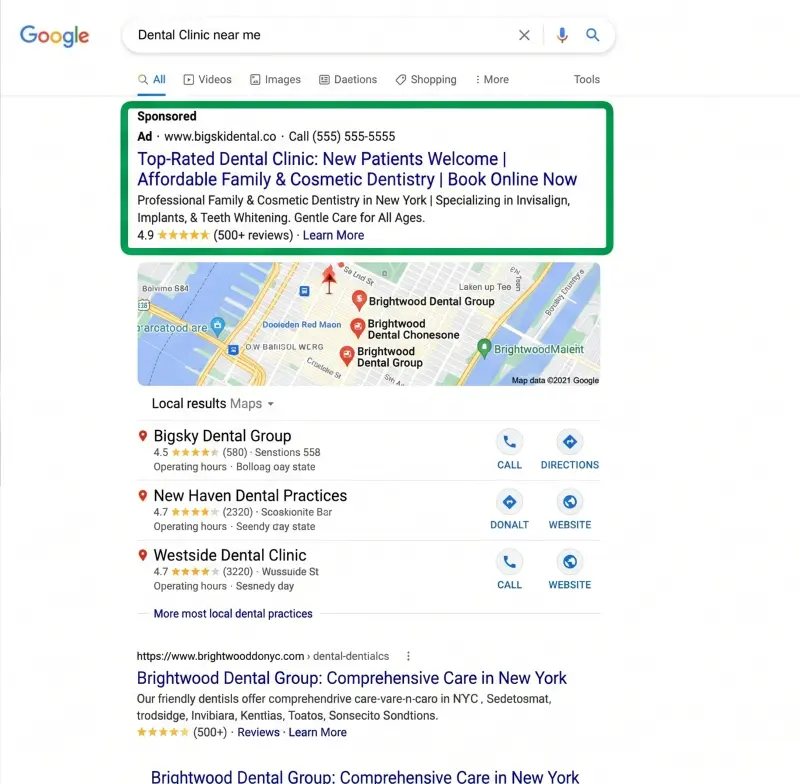
Target // Cost per qualified lead down 31% by day 90, without reducing impression share on money terms.
[02 // Meta Ads Demand Generation]
02 / 04Manufacture demand before the search.
On Meta, creative is the targeting. We do not buy audiences and hope a static works; we run a hook × angle × format matrix—three hooks, four angles, three formats, thirty-six cells per sprint—and let spend decide which combination earns scale. Every asset is tagged by hook and angle in the campaign name, so performance can be read at the concept level rather than the ad level.
Measurement is server-side. Conversions API fires through server-side GTM with a deduplicated event ID against the browser pixel, enhanced matching sends hashed email and phone where consent allows, and offline lead quality is fed back so lookalikes build from closed customers instead of cheap leads. Kill rules are written before launch: an ad dies at 95% confidence of underperformance or at three times the target CPA in spend, whichever comes first.
Non-negotiable // Every test cell is pre-funded to a readable sample. No “winner” is called on 48 hours of data.
Deliverables ledger
Spec
- Hook × angle × format creative matrix
- 36 cells
- CAPI event schema with dedup & matching
- sGTM
- Audience exclusion map, stage by stage
- 1 map
- Kill / scale rulebook with thresholds
- Signed
- Creative performance ledger by concept
- Weekly

Target // Cost per booked call inside 1.4× of search CPA, measured server-side against CRM outcomes.
[03 // Conversion Rate Optimization]
03 / 04Find the friction before you buy more traffic.
A CRO engagement starts with a heuristic audit, not a redesign pitch: a twelve-point friction checklist scored against your three highest-traffic templates, then corroborated with evidence. We review 100 session recordings per funnel step, read form analytics field by field, and map drop-off against the exact question your visitor is asking when they leave. Hypotheses that survive the evidence become tests. The rest are discarded, in writing.
Tests are prioritized on a PXL-style score of impact, confidence, and effort, then run sequentially on one variable at a time. Every brief is pre-registered with a minimum detectable effect and a required sample size before the first visitor sees it. We do not call a winner early, we do not stack three changes into one test, and we publish losses in the monthly ledger with the same prominence as wins.
Non-negotiable // Minimum detectable effect and sample size are written into the brief before launch. Visible to the client.
Deliverables ledger
Spec
- Heuristic friction audit, 12-point
- 3 templates
- Session replay review, annotated
- 100 / step
- Prioritized test backlog, PXL scored
- Ranked
- Pre-registered test briefs with MDE
- Per test
- Win / loss ledger with confidence intervals
- Monthly

Target // One statistically defensible lift per quarter. Every point of conversion rate lowers the ceiling on paid CPA.
[04 // High-Converting Landing Pages]
04 / 04One promise. One action. No navigation.
Paid traffic should never land on a homepage built for six audiences. We build a dedicated page per offer, per channel, with the ad’s exact promise repeated as the H1 in seven words or fewer. No main navigation, no competing links, one primary action repeated three times down the page. Proof sits where skepticism spikes: above the form, beside the price, under the CTA.
The build is static, hand-written, and fast. Under 100KB of JavaScript, LCP under 2.0s on a throttled 4G connection, Lighthouse performance and accessibility at 95 or better before launch. Forms cap at three fields, inputs carry correct types and autocomplete tokens, and the full page is keyboard navigable at WCAG AA contrast. Conversion tracking and CAPI events are QA’d in staging before a single dollar is spent.
Non-negotiable // No page ships without a passing speed report, an accessibility pass, and a fired test conversion.
Deliverables ledger
Spec
- Message-match wireframe and copy document
- 1 doc
- Production build, static and hand-coded
- Deployed
- Speed and accessibility report, Lighthouse
- ≥ 95
- Conversion QA checklist, forms and events
- 42 points
- Variant roadmap for the next 90 days
- 90 days

Target // Every paid click lands on a page that repeats the ad’s promise in the first viewport.
[Due diligence // The Buyer’s Matrix]
The agency
comparison matrix.
Six rows. No adjectives. Bring this table to your next agency pitch and ask each firm to answer line by line—then check the answers against the actual ad account.
Criterion // 06
Traditional retainer agency
Supreme Ads Agency
Criterion 01
The scorecard
Traditional
Impressions, CTR, engagement rate, and a monthly deck of screenshots. Success is defined as activity.
Supreme Ads
Cost per qualified lead, cohort payback period, and blended ROAS net of media cost. Success is defined as profit.
Criterion 02
Who touches the account
Traditional
A junior buyer carrying 25–40 accounts, reassigned every few quarters. Account churn is the business model.
Supreme Ads
A named pod: senior strategist, senior buyer, CRO engineer, and designer. Six accounts per pod, capped in writing.
Criterion 03
Creative production
Traditional
Two statics a month and a generic AI paragraph recycled across every client in the vertical.
Supreme Ads
Twenty-four assets per sprint, each tagged to a specific hook and angle in a documented test matrix.
Criterion 04
The data layer
Traditional
Browser pixel only. Last-click attribution. iOS opt-outs quietly erased from the report.
Supreme Ads
Server-side CAPI, deduplicated events, and CRM offline conversions feeding the bidding algorithm.
Criterion 05
The conversion layer
Traditional
Sends every click to the homepage and blames the traffic when it does not convert.
Supreme Ads
Custom CRO pages built per offer and per channel, tested and rebuilt before media spend scales.
Criterion 06
How spend scales
Traditional
Budget rises when the client asks, or when the retainer needs to justify itself against spend.
Supreme Ads
A mathematical profit scale: budget moves only after a cohort clears a written payback threshold.
[CRO // The Conversion Engine]
The 20-minute
ad account teardown.
Leave with 3 wasted-spend leaks, 1 offer bottleneck fix, and a mathematical forecast of your traffic capacity. No deck. No pitch.
Three wasted-spend leaks, ranked by dollar impact.
One offer bottleneck fix you can ship this week.
A mathematical forecast of your traffic capacity.
Prefer email? info@supremeadsagency.com
Request the teardown // 3 fields